







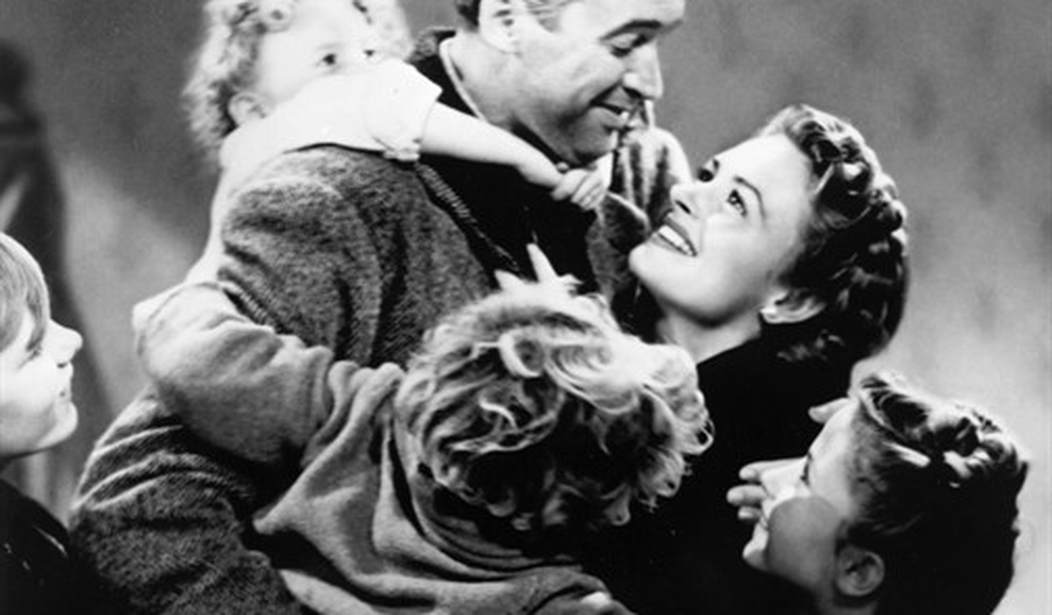

One of the best parts of Christmas is the movies. It's not the holiday unless I get to watch 'Die Hard' and 'A Christmas Carol' (I prefer the 1984 adaptation starring George C. Scott as Scrooge) and 'It's a Wonderful Life.'
That last one has an interesting backstory. It was Jimmy Stewart's first post-war movie; the scene where George Bailey breaks down at the bar was Stewart letting out a lot of his emotions. After filming, it was clear the camera focus was off and the scene blurry. Director Frank Capra wanted to reshoot the scene, but Stewart said he couldn't do that again, so the editors worked with what they had to clean up the footage.
The film was also a flop when it was released in December, 1946 -- it failed to recoup its costs and was met with negative reviews. It wasn't until 1974, when the film's copyright was up for renewal (and owner Republic Pictures failed to renew that copyright) that it became the Christmas classic we know today.
Without copyright, any station could play the film, and it became an oft-televised classic.
The emotional heart of the film is when George Bailey -- having spent his life doing the right thing, usually at great personal cost -- sees what the world looks like without his hand in it. Not only is his family upended, but the landscape of his beloved Bedford Falls -- known in that alternate timeline as Pottersville -- is altered for the worse.
It is an ugly vision and it shows George that he made a difference.
So for Amazon to not only edit the film, but cut out George visiting Pottersville, is an affront to the very message of the movie:
If you want to know what’s wrong with the world, Prime Video has an “abridged” version of It’s a Wonderful Life that removes THE ENTIRE POTTERSVILLE SCENE where George sees life if he wasn’t born.
— Germain Lussier (@GermainLussier) December 24, 2024
That’s all that abridged. The best most crucial part of the movie. Just. Wow. pic.twitter.com/H8Z82lGk9X
This edit not only removes the emotional core of the movie and of George's character arc, it makes the entire point boil down to money. It implies the angel Clarence...gives?...George the $8,000 he needs and everything is right with the world.
It's not. George's breakdown is not about the money. It's about a man who had dreams: dreams of college, dreams of travel, dreams of a career outside his dad's building and loan who constantly put those dreams on hold or let those dreams go to help his family, the business, and the town. George did everything right, he made sacrifice after sacrifice, and for all that he was looking at major legal trouble because his uncle lost $8,000 and Mr. Potter wanted George arrested for bank fraud.
He felt his life didn't matter after all of that, and especially not after Potter pointed out his life insurance made George worth more dead than alive. That's what lead George to the bridge that night, where he would have likely jumped into the river had Clarence not intervened by jumping in the river first.
But even after rescuing Clarence, George is still despondent and hopeless. He still wishes he'd never been born.
For that attitude to change George needed a very stark lesson in what it truly meant for him to never have been born. Not only is Bedford Falls morphed into the seedy Pottersville, George's mom runs a shady flop house, George's brother Harry died as a child (thus dooming a WWII transport of military to die, too), and the ripple effect of George's absence is far-reaching.
Seeing that is the wake-up call George needs. It is what gets him to stop wishing he'd never been born and grateful for the life he had.
As my colleague noted here, 'It's a Wonderful Life' packs an emotional punch at Christmas and it still resonates with viewers. This makes the abomination of what Amazon did that much more offensive.
Yes, 'It's a Wonderful Life' is just over two hours long (long for 1946 standards). But every second of that runtime is needed: it builds up who George is from childhood, showing us what he does and why he does it, and why it ultimately leads him to the bridge that night.
Cutting the most pivotal sequence -- which only lasts about 20 minutes -- takes everything the movie is leading towards and erases it. Thus undermining the entire message of the movie.
A message and a lesson that audiences need, now more than ever.
It is a lesson that is as timeless as it is important: every life, even those that seem mundane or inconsequential, have an impact on those around them and, as Clarence tells George, 'Remember, no man is a failure who has friends!'