








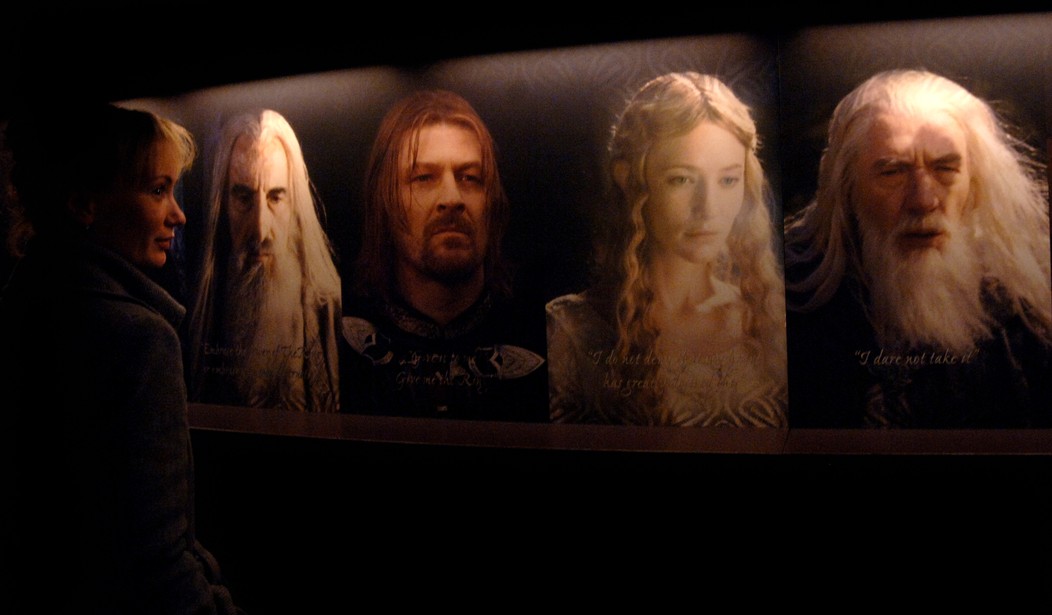

If you're a nerd like me, and you love 'The Lord of the Rings' as much as I do, today holds special significance. It is the day Frodo and Sam reached the fires of Mount Doom and destroyed the Ring, freeing Middle Earth from the grasp of the dark lord Sauron.
March 25th: The Ring is Destroyed #TolkienReadingDay pic.twitter.com/h0XqPzwevw
— Tea with Tolkien (@TeawithTolkien) March 25, 2024
It was not an easy journey. From the time Frodo left the Shire to the day the Ring fell into the fire, it was 182 days, or roughly six months, and that doesn't include the return trip home.
J.R.R. Tolkien wrote the fantasy that would become 'The Silmarillion' and 'The Lord of the Rings' during World War I, and scholars and other authors (like C.S. Lewis) saw the trilogy as a response to that Great War and the conflicts between 1914 and 1945 (although Tolkien himself denied a connection to WWII). C.S. Lewis said of the war in 'Lord of the Rings':
This war has the very quality of the war my generation knew. It is all here: the endless, unintelligible movement, the sinister quiet of the front when 'everything is now ready',[b] the flying civilians, the lively, vivid friendships, the background of something like despair and the merry foreground, and such heavensent windfalls as a cache of tobacco 'salvaged' from a ruin.[c] The author has told us elsewhere that his taste for fairy-tale was wakened into maturity by active service; that, no doubt, is why we can say of his war scenes (quoting Gimli the Dwarf) 'There is good rock here. This country has tough bones.
I am eternally fond of Sam's quote: 'There is good in the world, Mr. Frodo. And it's worth fighting for.' Because there is. And on this day where, in fiction, the great evil threatening Middle Earth was obliterated, there are themes in 'Lord of the Rings' that are relevant and vital to today, when it feels like a great battle between good and evil is underway, and a great many things seem hopeless and dark.
First is the theme of friendship and companionship. While the task Frodo faces is an arduous one -- one he and Gandalf both recognize he might not survive -- Frodo does not go alone. He is joined by the Fellowship, and after they part ways, Sam remains his stalwart companion as they walk through literal hell on Earth. Even after the events of the book, the Fellowship remain in contact and friends for the rest of their days. Hold tight to your friends and your loved ones. Stand strong together.
Second is the theme of sacrifice and redemptive suffering. Frodo suffers on his quest to destroy the Ring. His absence from the Shire, the physical demands of such a long journey, the stab wound inflicted on him by the Witch King at Weathertop, and the burden of the Ring itself all take their toll on Frodo. He is never the same, despite surviving his quest. The stab wound never fully heals (not forgetting the mental and emotional toll the journey took on him), and from his return to the Shire until he sails to the Undying Lands he struggles. Greatly. But his sacrifice and suffering save Middle Earth from a terrible fate.
Perhaps it's appropriate that this year the Tolkien Society chose 'Service and Sacrifice' for its theme on this Tolkien Reading Day.
Today is #TolkienReadingDay!
— Tolkien Society (@TolkienSociety) March 25, 2024
Held every year on 25th March, the date the Ring was destroyed, this is an opportunity to read your favourite passage from the works of J.R.R. Tolkien. This year's theme is "Service and Sacrifice". What will you be reading? https://t.co/EWCGybBEwh
The third is hope. 'Lord of the Rings' has both false hope, as when Eomer tells Aragorn 'hope oft deceives' during the Battle of the Pelennor Fields, or when Gandalf tells Pippin that Frodo's quest was one of a 'fool's hope'. Hope and optimism are not one in the same in Middle Earth; optimism is often lacking given the dire circumstances faced by the Fellowship. But Legolas also notes that 'oft hope is born, when all is forlorn.' Hope is there, even if optimism is not, and especially when things seem to be lost.
The other thing to remember -- one that is vital in a day when everything is politicized -- is the importance of fantasy as an escape from the day to day.
To all who love hobbits, elves, dwarves, dragons, magic rings, and all things from the work of Catholic writer J.R.R. Tolkien, Happy March 25 #TolkienReadingDay ... pic.twitter.com/YpWaepgTvy
— Catholic Central (@CatholicC_TV) March 25, 2024
I like that: 'It is our plain duty to escape, and to take with us as many people as we can.'
Sam tells Frodo, 'How could the world go back to the way it was when so much bad had happened? But in the end, it's only a passing thing, this shadow. Even darkness must pass. A new day will come. And when the sun shines it will shine out the clearer. Those are the stories that stayed with you...Folk in those stories had lots of chances of turning back, only they didn't. They kept going, because they were holding onto something.'
We are those people in those stories. We will keep going, and so will we.
***
Editor's Note: Do you enjoy Twitchy's conservative reporting taking on the radical left and woke media? Support our work so that we can continue to bring you the truth. Join Twitchy VIP and use the promo code SAVEAMERICA to get 50% off your VIP membership!