
Regular readers know that there are two ‘Dan Sullivans’ on the ballot for the U.S. Senate in Alaska this coming Tuesday. One is an incumbent Republican senator; the other is a relative unknown. The accusation has been out there for months that the less famous Dan Sullivan was only on the ballot in a ploy to confuse voters who might have intended to vote for the incumbent. With the controversy blowing up the way it is, we wonder if very many people will fall for that, now, but that was the fear among Republicans and the clear hope among Democrats.
Surprisingly, within the last week, the New York Times of all papers brought forth evidence that members of the Democratic Senatorial Campaign Committee and aides associated with Senator Sullivan’s opponent, Mary Peltola, conspired to recruit the ‘Fake Sullivan.’ Of course, these allegations have yet to be proven in a court of law, but if the New York Times prints anything that makes Democrats/leftists/communists look bad, that is kind of the gold standard of truth telling. Because of their extreme bias against Republicans/conservatives/MAGA, they wouldn’t say anything that might help that trio of groups unless they really thought it was true — and maybe not even then.
And we have heard a lot of people declare that this is legal. For instance, The Bulwark published this:
"Mary Peltola’s dirty trick was legal. End of story. So quit your whining, Republican snowflakes. You like that? Great. Now let me make you angry by yelling at some progressive whiners."https://t.co/YTo9UhCizf
— The Bulwark (@BulwarkOnline) October 30, 2026
This links to a paid article from Jonathan V. Last. We aren’t going to spend actual money on their drivel, but here’s what they say before the firewall of sanity paywall shuts us down:
Mary Peltola’s team did something not nice and unsportsmanlike. They went and found another guy named Dan Sullivan and got him on the ballot in their race against incumbent Sen. Dan Sullivan.
Republicans are outraged—not just random Republicans on X, but national, elected Republicans. They have sued. They are calling on Peltola to drop out of the race. They are demanding that if Peltola wins the election, her victory not be certified, or she not be seated. President Trump has said Peltola should be prosecuted.
AYFKM?
Is Peltola’s trick illegal? No. It is perfectly within the law.
Is Peltola’s trick dishonest? No. No reasonable person could be confused by the Dan Sullivans on the ballot.
That would be from the Bulwark, which claims it is all about protecting Democracy. For instance, on their YouTube channel they say
The Bulwark was founded to provide analysis and reporting in defense of America’s liberal democracy.
That’s it. That’s the mission.
Yet somehow, deliberately deceiving voters is not a problem for them. How shameful.
Then again, these days Democrat politicians are all about deception, aren’t they? Putting this mess aside, they massage and outright lie about their positions, trying to make people think that they are moderates. Then when they are elected, they drop the mask and act as radicals. How is that consistent with democratic principles?
And Last's second assertion — that no ‘reasonable person’ would be confused — flies in the face of the fact that the New York Times alleges that this was the cabal's purpose in doing it. That’s a bit like a gangbanger saying ‘sure, I shot the guy in the head in order to kill him, but I didn’t think he would die.’ Obviously, if you shoot a person in the head, they might live, but in that scenario, murder is precisely what he was trying to do and with the ‘Decoy Dan’ scheme, the specific goal is to do exactly what Last is discounting, at least according to the New York Times.
As for legality, he offers no actual explanation of why he thinks it is legal. There is no mention of any statute that sounds like it might apply and Last explaining why it doesn’t or any other substantive discussion. Maybe that kind of discussion is behind the paywall, but we repeat: We are not paying for this drivel.
But we have even seen J.D. Vance say he isn’t sure if it is illegal and say that something to the effect of ‘if it isn’t illegal, it ought to be.’
Now, let’s play pretend and imagine that the bare act of recruiting a decoy candidate is legal. We’re not saying it is — in fact, to jump ahead, we think it isn’t — but let’s play pretend, shall we? We have said repeatedly that if you want to try to outsmart the law and do something wrong, while hoping that it is still technically legal, that is a losing proposition. First, you just might not understand the law well enough to avoid breaking it. Second, there are so many laws out there that no one literally knows all of them. We are pretty confident in saying that there isn’t a lawyer alive who has memorized the entirety of the U.S. Code or even feels particularly familiar with all of it, which is only one of fifty bodies of statutes in America, not to mention those of the territories and Washington, D.C., or, for that matter, common law crimes (essentially judge-made crimes, which do exist on the state level, and not the federal level). It is often claimed that the average American commits at least one technical crime every day (not counting going five miles over the speed limit). And so even if the bare act is legal, a prosecutor who is angry at you for what you did can probably find something illegal you did while doing that technically legal thing. In short, it is a bad idea to try to ‘outsmart’ the law, and you shouldn’t even try. If it is morally wrong and you offend prosecutors enough, they will find a way to lock you up.
But is the bare act illegal? Is it legal to recruit a person with a similar name to another candidate solely in order to deceive voters, not because you think the person can win or even want him or her to win?
Well, one guy has something to say on the subject:
The DOJ should prosecute to the fullest extent of the law this illegal conspiracy to steal votes from Alaskans.
— Douglass Mackey (@douglassmackey) October 28, 2026
Unlike a joking parody meme mocking @HillaryClinton, this is an actual federal crime.
GIFT LINK: https://t.co/auoOfhfPOC https://t.co/676UoD0Hd0
Now, this guy is not a lawyer or even a graduate of law school as far as we know. But he had a different kind of education in the law through life experience, and we think he is right.
As the title indicated, Douglass Mackey is most famously known as Twitter/X user 'Ricky Vaughn,' named after Charlie Sheen’s character in the classic comedy ‘Major League.’ Basically, during the 2016 election cycle, Mackey posted a number of memes that said you could vote by text on your phone. This is one of those memes:
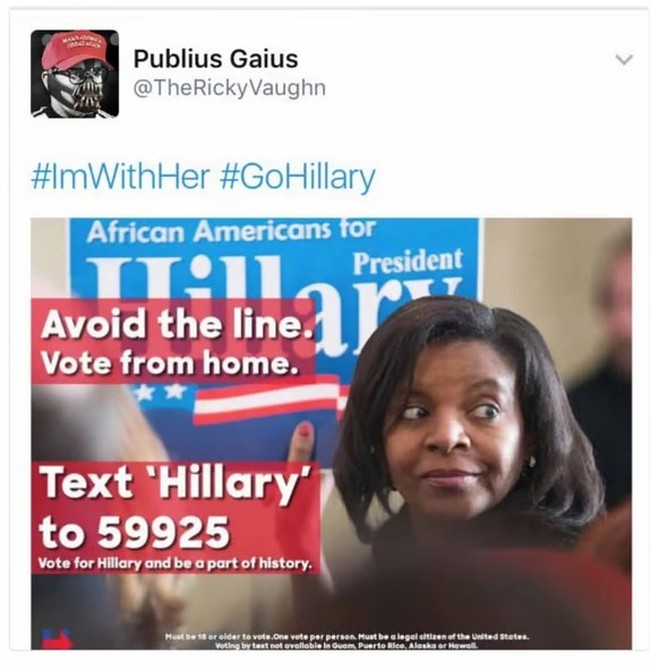 The other memes were basically the same in every relevant fashion. Mackey asserted it was a joke and literally no one fell for it, but the Biden administration wasn’t laughing. He was ultimately tried and convicted under 18 U.S.C. § 241, generally known as the Enforcement Act of 1870, basically an anti-Klan act. It reads as follows:
If two or more persons conspire to injure, oppress, threaten, or intimidate any person in any State, Territory, Commonwealth, Possession, or District in the free exercise or enjoyment of any right or privilege secured to him by the Constitution or laws of the United States, or because of his having so exercised the same; or
If two or more persons go in disguise on the highway, or on the premises of another, with intent to prevent or hinder his free exercise or enjoyment of any right or privilege so secured—
Then it goes on to list various punishments if you did those things listed in those two paragraphs, including enhancements up to and including the death penalty depending on various factors not really relevant here.
Now, obviously the second paragraph doesn’t apply at all. But the first paragraph is what prosecutors hung their hat on in the Mackey case. The ‘right or privilege secured to him by the Constitution’ is the right to vote. (You might remember in the law, male pronouns can often encompass women, so ‘him’ can include ‘her'.) And, of course, what he did was either an injury or an oppression in that right to vote, in the eyes of the prosecution — and ultimately the court that convicted him. And to square the circle a bit, while we won’t dig into every element of what counts as a conspiracy, the basic idea is that a criminal conspiracy is an agreement to commit a crime — in this case, a conspiracy to do the rest of the things forbidden by this statute. There is more to it than that, but that’s enough to get you through this.
So, let’s back up a second here. Mackey was convicted, which meant that a jury found that he conspired to injure or oppress Americans in their right to vote by disseminating false information that may have harmed their ability to vote for the candidate of their choice.
Are you starting to see the relevance of this discussion to the alleged ‘Decoy Dan’ scheme up in Alaska?
Now, let’s get something out of the way. We hear people complain ‘Mackey was convicted over a Tweet!’ (it was called Tweeting back then, youngins!), or ‘he was convicted over a meme.’ There is no doctrine in the law that says that if you write something on Twitter/X that there can’t be a prosecution — or civil consequences, for that matter. If you wrote a threat to kill the president today on Twitter/X, in earnest, and the Federal Government can prove it, you are going to prison. If you dress it up as a meme, same result. In fact, you can even spell out a threat in seashells and get validly charged with a crime, as James Comey has surely learned by now.
And, while Mackey did claim it was just a joke, the judge and the jury did not buy it. They convicted him, anyway. We’re not saying it wasn’t a joke, just that the claim that it was a joke didn’t save his bacon.
(Don’t interpret anything we have said as indicating that we like Mackey. This author used to follow one of his personas on Twitter (back when it was called Twitter, youngins!) and we saw him say some things that offended us enough to unfollow him. But we do like us some free speech and that’s why we opposed his prosecution.)
Still, Mackey was ultimately set free in this case before the Second Circuit Court of Appeals…
Thinking about this case tonight: https://t.co/UqoxsjgsuQ
— (((Aaron Walker))) (@AaronWorthing) November 1, 2026
… and the grounds for setting him free were very narrow: The Government didn’t present sufficient evidence to establish that he was in a conspiracy. That’s where the case failed and that is the only reason for its failure.
To dig a little deeper, Mackey was apparently in a Direct Message discussion (what we now call chat, youngins!) where other people talked about getting together to trick people into thinking they could vote by text. However, the government offered insufficient evidence that Mackey actually agreed to do that, or even saw those specific messages. Anyone who has been in a sufficiently large group chat over many days can attest to how easy it is to miss old messages. In other words, they couldn’t prove he wasn’t just acting on his own when he tweeted out those memes.
And as you might recall, the statute requires a conspiracy of at least two people. Two white Democrats wearing white hoods and robes, and burning a cross on a black family’s lawn in an effort to scare them away from voting might trigger this federal statute. But one lonely white hooded, robed Democrat doing that hasn’t committed that crime. He is likely to have committed at least one state crime and maybe even other federal crimes, but he has not committed this specific federal crime.
So, with insufficient evidence of a conspiracy involving two or more people (all conspiracies require at least two people — this is a redundancy in the law), the Second Circuit Court of Appeals vacated Mackey's conviction and ordered him to be acquitted. He was set free, reportedly without ever spending a day in jail or in prison.
And, well… that defense is not likely to work in ‘fake Dan Sullivan’ scheme if the New York Times reporting is correct. Even if it was just one person recruiting ‘Decoy Dan’ into the scheme, that’s a conspiracy: The recruiter and the decoy candidate are the two conspirators in that scenario. And if the object of the conspiracy is to oppress or injure Alaskans in their right to vote, then it starts to sound like a violation of the Enforcement Act.
This is especially true when you examine the opinion of the lower court holding that Mackey could be tried under § 241, which you can read here:
And also thinking of the lower court decision in the same matter. https://t.co/qqmmIgd4MZ
— (((Aaron Walker))) (@AaronWorthing) November 1, 2026
At this point in time, there hadn’t been a trial so the Court had to deal with only the allegations that the government made against Mackey. So, the Court determined that if a jury found that there was a conspiracy and, that he sent those memes in earnest, that putting the memes out could be considered injuring or oppressing people in their right to vote, in violation of § 241. In doing so, The Court gave a short overview of the history of § 241 prosecutions in relationship to the right to vote. The Court does it under a doctrine known as ‘fair warning’ but it also functions as demonstrating that this is in fact how the law has been interpreted and its worth quoting from the decision extensively:
In order to properly assess whether fair warning was given to Defendant Mackey, this court must understand the scope of prior prosecutions under the statute. For a fair warning analysis, ‘the pre-existing law may be found in appellate as well as lower court decisions.’ United States v. Melendez, No. 03-80598 (AC), 2004 WL 162937 at *6 (E.D. Mich. Jan. 20, 2004). § 241’s fair warning doctrine focuses most centrally on the right that has been violated — in this case, the right to vote. A fulsome review of the federal courts’ § 241 voting rights cases to date thus constitutes the court’s best available tool for determining whether fair warning for the instant prosecution was given.
Section 241 was originally enacted as Section 6 of the Enforcement Act of 1870. Like other provisions of the Enforcement Act, Section 6’s original focus was on enforcing reconstruction’s promise of suffrage for southern Black men in the face of significant violence and pushback from the Ku Klux Klan, then in its heyday. ERIC FONER, RECONSTRUCTION: AMERICA’S UNFINISHED REVOLUTION 1863-1877 454 (2005 ed.). As Congress and the Supreme Court retreated on the issue of reconstruction, bowing to political forces in the South, much of the Enforcement Act was struck down or repealed. Id. By the end of the era, only Section 6 and its sister provision Section 7, now Sections 241 and 242, remained in force. Id. at 454-55. From their start, these statutory provisions were largely about voting rights ‘secured ... by the constitution and laws of the United States of America.’ Ex parte Yarbrough, 110 U.S. 651, 4 S.Ct. 152, 28 L.Ed. 274 (1884) (‘The Ku Klux Cases’); see also United States v. Butler, 25 F. Cas. 213, 220 (D.S.C. 1877). Although ‘the source of this section in the doings of the Ku Klux and the like is obvious, and acts of violence obviously were in the minds of Congress’ when legislating, the statute has since been used to prosecute a wide range of non-violent conspiracies entered into with the intent to injure, oppress, threaten, or intimidate free exercise of the right to vote as well as other constitutional and federal rights. United States v. Mosley, 238 U.S. 383, 387-88, 35 S.Ct. 904, 59 L.Ed. 1355 (1915) (‘§ 6 being devoted, as we have said, to the protection of all Federal rights from conspiracies against them, naturally did not confine itself to conspiracies contemplating violence[.]’). And, ‘in determining whether a provision of the Constitution applies to a new subject matter, it is of little significance that it is one with which the framers were not familiar. For in setting up an enduring framework of government, they undertook to carry out for the indefinite future and in all the vicissitudes of the changing affairs of men.’ Classic, 313 U.S. at 316, 61 S.Ct. 1031.
…
The first election-related § 241 case on record took place in 1877, when two election officials were prosecuted under the statute for conspiring to kill a Black man because he supported a Republican rather than a Democrat in a federal general election. United States v. Butler, 25 F. Cas. 213, 220 (D.S.C. 1877). But by the 1910s, the statute was also used to prosecute less violent conspiracies against voting rights. In 1911, local election officials were indicted for conspiring to make ballots intentionally confusing for one party’s voters. United States v. Stone, 188 F. 836, 838-39 (D. Md. 1911). In 1915, officers of a county board of elections were indicted for conspiring to omit certain votes from the vote count. United States v. Mosley, 238 U.S. 383, 385, 35 S.Ct. 904, 59 L.Ed. 1355 (1915).
In 1918, the Supreme Court cabined the growing doctrine slightly, holding in United States v. Bathgate that bribing voters was not an infringement on the right to vote under Section 241. 246 U.S. 220, 227, 38 S.Ct. 269, 62 L.Ed. 676 (1918). The Court reasoned first that it could not construe § 241 to cover conspiracies to bribe voters because Congress had made its wishes clear by expressly repealing a different section of the act which dealt specifically with bribery. Bathgate, 246 U.S. at 226, 38 S.Ct. 269. The Court further reasoned that the right to vote at issue under this statute was the personal right to vote rather than the general political right to vote; under the Bathgate scheme, although the vote count totals were manipulated, individuals maintained their personal right to vote. Id. at 226-27, 38 S.Ct. 269.
But Bathgate’s limitation of the statute was an anomaly. In the 1930s, the Department of Justice (the ‘DOJ’) prosecuted an ever-broader range of voting rights cases under this statute, with the understanding that injuring the right to vote included both hampering a qualified voter’s ability to cast their vote and failing to count a vote properly cast. See United States v. Pleva, 66 F.2d 529, 530 (2d Cir. 1933) (addressing election inspectors that conspired to tally the ballots incorrectly); United States v. Buck, 18 F. Supp. 213, 215 (W.D. Mo. 1937) (prosecuting election commissioners that conspired to injure voters’ rights by counting certain votes for a different candidate); United States v. Clark, 19 F. Supp. 981 (W.D. Mo. 1937) (holding that changing votes after polls had been closed could also be prosecuted under this statute); Walker v. United States, 93 F.2d 383, 388 (8th Cir. 1937) (county election officials ‘conspired to count, record, and certify the ballots of voters [in a presidential election] falsely with fraudulent intent’); Ryan v. United States, 99 F.2d 864, 867-68 (8th Cir. 1938) (holding that a jury was correct in finding that ballots were falsified and other ballots were changed from Democratic to Republican by a certain ward’s Republican Committee-woman).
In United States v. Classic, 313 U.S. 299, 61 S.Ct. 1031, 85 L.Ed. 1368 (1941), the Court made clear that it viewed the statute as flexible enough to be used in situations that were new but implicated the same rights, as both the nature of the right to vote and the most effective ways to oppress voters’ rights naturally shifted over time. United States v. Classic, 313 U.S. 299, 61 S.Ct. 1031, 85 L.Ed. 1368 (1941). The Court considered an alleged conspiracy to miscount votes in a Louisiana primary election, where the power to elect a Louisiana representative to Congress had functionally shifted to the primary elections, as those primaries limited who citizens would be able to choose on the general election ballot. Id. at 308-09, 61 S.Ct. 1031. The Court held that Section 241 could be used to prosecute interference with the right to vote in a Louisiana party primary election, although it was not technically a federal election, because that interference was actually interference with the broader right to vote, and was merely taking place ‘at the only stage of the election procedure when [voters’] choice is of significance ... [or] could have any practical effect on the ultimate result, the choice of the Congressman to represent the district.’ Id. at 314, 61 S.Ct. 1031. In other words, § 241 could be violated at any stage that represented an ‘integral part of the procedure for the popular choice’ and in any way that injured their ‘right to participate in that choice,’ regardless of whether the method for doing so was ‘one with which the framers were not familiar.’ Id. at 314, 316, 61 S.Ct. 1031.
Throughout the 1940s, 50s and 60s, the Department of Justice continued to prosecute cases against those who used a variety of methods to injure or oppress the ‘personal right of the elector to cast his own vote and have it honestly counted.’ Saylor, 322 U.S. at 387, 64 S.Ct. 1101; see Klein v. United States, 176 F.2d 184, 185 (8th Cir. 1949) (addressing conspiracy to hinder properly registered voters and cause unqualified voters to vote in the name of qualified voters); Prichard v. United States, 181 F.2d 326, 327 (6th Cir. 1950) (stuffing ballot boxes); Crolich v. United States, 196 F.2d 879, 880 (5th Cir. 1952) (stuffing ballot boxes); United States v. Nathan, 238 F.2d 401, 403 (7th Cir. 1956) (‘pollution of the ballot box’ by submitting ballots from fake voters); Fields v. United States, 228 F.2d 544, 547 (4th Cir. 1955) (discussing conspiracy to incorrectly fill out ballots on behalf of illiterate voters who thought they were receiving assistance in voting); United States v. Skurla, 126 F. Supp. 713, 715 (W.D.Pa. 1954) (considering situation where conspirators forged false ballots, ‘caused an incorrect tally of the votes cast to be returned’ and paid people ‘to impersonate lawful voters and to cast illegal votes’); United States v. Ellis, 43 F. Supp. 321, 324 (W.D.S.C. 1942) (‘[T]he right to vote in a Federal election comprehends and includes the right to register for a General Election.’); United States v. Chandler, 157 F. Supp. 753, 754 (S.D. W. Va. 1957) (falsified absentee ballot voting).
Over the last fifty years, indictments under § 241 have continued to evolve in order to adequately address injuries to the right to vote, as modes of voting and would-be wrongdoers’ corresponding methods for injuring those votes have shifted. Notably, a 1988 federal indictment under § 241 dealt with a relatively complex scheme to intentionally misdirect votes by absentee voters opposing the conspirators’ preferred candidate. United States v. Townsley, 843 F.2d 1070, 1073-75 (8th Cir. 1988). In that case, the ‘Democratic Committeeman’ for a ward organization in St. Louis had workers in that organization qualified as notaries. Id. at 1074. He then required those notaries to go to absentee voters’ houses to notarize and retrieve their ballots, but to leave those ballots partially unsealed and bring them directly to his office. Id. The committeeman would then check each ballot and submit only those ballots in favor of his organization’s candidate. Id. Although the circuit reversed the district court on an unrelated issue, it noted that the § 241 count of the indictment was sufficient to sustain a verdict. Id. at 1086. Similarly, in United States v. Olinger, a precinct captain was indicted under § 241 after he instructed election judges purporting to assist elderly and mentally ill voters to instead ‘punch 10’ on each resident’s computerized ballot, resulting in a vote for all Democrats on the ballot. United States v. Olinger, 759 F.2d 1293, 1297 (7th Cir. 1985).
More recently, in United States v. Tobin, the Department of Justice prosecuted a defendant under § 241 for allegedly conspiring to ‘disrupt the telephone lines’ through which voters could seek assistance from the state Democratic party or firefighters ‘to impede or prevent voters who needed transportation from getting to the polls,’ in order ‘to prevent voters from casting votes for Democratic candidates in the federal election.’ No. 04-CR-216-01 (SM), 2005 WL 3199672, at *1 (D.N.H. Nov. 30, 2005). Although the jury did not ultimately convict on the evidence presented, the district court found that defendant had fair warning and the indictment survived the corresponding motion to dismiss. Id. at *4 (‘That a conspiracy or agreement to interfere with the free exercise of the right to vote would violate § 241 is established in the prior decisions of the Supreme Court. Fair warning is given by the statute and decisional law that such conduct is prohibited.’).
In sum, the statute’s historical usage shows that the indictment before the court today is the latest in a long line of electoral and voting rights prosecutions under 18 U.S.C. § 241. For more than a century, courts have held that this statute flexibly proscribes conspiracies to injure the right to vote in a variety of contexts and undertaken using a variety of mechanisms.
(Footnotes omitted.) We admit that is a lot to pick through but it establishes 1) that harming a person’s right to vote can trigger the statute, and 2) tricking a person into voting for someone they didn’t intend to can also trigger the statute. (Look particularly at the discussion of United States v. Olinger and Fields v. United States above where people pretended to help people vote so they could alter their vote.)
Thus this author thinks that if it was proven that one or more people conspired to get ‘Decoy Dan’ to run, that could turn into a prosecution and even a proper conviction under § 241. And if the defense challenges that prosecution, they could basically just cut and paste that passage from the Mackey decision into their brief. Indeed, the Mackey case itself adds to the pile of citations — when a decision is overturned on other grounds, the remaining grounds are seen as at least what lawyers call ‘persuasive authority.’ It means that no other court is required to follow their lead, but a hypothetical Alaskan federal judge is likely to read this opinion carefully as a learned examination of the subject. Indeed, there is nothing literally wrong with that decision. The judge in the district was asking whether the prosecutions’ allegations, if true, added up to a crime and said it would. The Second Circuit didn’t doubt that if the allegations were proven, it would be a crime: They just said there wasn’t sufficient evidence to prove the allegations of conspiracy. They didn’t say the lower court’s reading of the law was wrong: They said that the evidence didn’t support that application of the law in the form of the verdict.
The only counterpoint we have heard is when people reply, ‘but… the Alaska Supreme Court still let ‘Decoy Dan’ on the ballot. So how could it be illegal?’
Now first, it is true that the Alaska Supreme Court did announce that they were going to let ‘Decoy Dan’ on the ballot:
And for some reason, I am also thinking about this case: https://t.co/bJZ2Hx6Azj
— (((Aaron Walker))) (@AaronWorthing) November 1, 2026
That is simply a one-page order, saying that the lower court was affirmed and that an opinion would be forthcoming. Except that order was issued at the end of June and we still haven’t gotten their opinion. But we can consult the order and opinion below that the Alaska Supreme Court affirmed:
And this, too: https://t.co/QdCVfOC1Uu
— (((Aaron Walker))) (@AaronWorthing) November 1, 2026
The meat of the opinion is this:
After receiving formal Complaints from the Alaska Republican Party, the Division of Elections (‘Division’) decided to exclude Mr. Sullivan’s name from the primary election ballot because it determined his declaration was not filed ‘in order to declare an actual good-faith candidacy for the office of United States Senator.’ Mr. Sullivan has filed an appeal to this Court alleging the Division’s decision is contrary to the expressed qualifications enumerated in the Constitution of the United States. Because the Court has determined the Division’s decision to exclude Mr. Sullivan from the primary ballot was based on a ‘good faith requirement that does not appear in the U.S. Constitution, the Alaska Statutes, or the implementing regulations adopted by the Division, the Division’s decision must be reversed.
(Footnotes omitted.) And you know what? We lean toward thinking that is correct. For instance, in US Term Limits, Inc. v. Thornton, 514 U.S. 779 (1995), the United States Supreme Court was confronted with an Arkansas Constitutional provision that set term limits on U.S. Congresscritters. But the Supreme Court held that this Arkansas Constitutional provision was contrary to the U.S. Constitution, which set very few restrictions on the ability to run for the U.S. Congress — and term limits were not found on that list. Unfortunately, ‘good faith’ is not a requirement to serve as a U.S. Senator, however much one might think it should be. We think ‘Decoy Dan’ has to be on the ballot. It is possible that the Alaska Supreme Court might suddenly rethink its order and pull ‘Decoy Dan’ off the ballot, but that doesn’t seem likely and we lean toward thinking that they would be wrong.
So, how could a conspiracy to recruit ‘Decoy Dan’ be a crime under 18 U.S.C. § 241, if he is entitled to be on the ballot?
Well, believe it or not, the lower court opinion in the Mackey case has an answer to that, too. Really, any Democrats who cheered on Mackey’s prosecution might end up eating some crow. Here’s what the Court said:
Finally, although many § 241 prosecutions involve some ‘independent wrongful conduct’ that would itself constitute a substantive crime, that is certainly not required under the statute. For instance, in Guinn v. United States, 238 U.S. 347, 35 S.Ct. 926, 59 L.Ed. 1340 (1915), the Supreme Court upheld a prosecution of Oklahoma state election officers who enforced the provisions of an amendment to the Oklahoma constitution that disenfranchised citizens whose lineal ancestors were illiterate as of January 1, 1866, as a conspiracy to violate the Fifteenth Amendment. Id. at 354, 35 S.Ct. 926. State officials enforcing their state’s own constitution can hardly be said to have been engaging in ‘independent wrongful conduct,’ though a conspiracy to do so did, in fact, violate Section 241.
The metaphor we would use is imagine this hypothetical scenario. Imagine, we had a president named Joe Bidding and he had a son named Seeker Bidding. (Any resemblance between any senile former president and his crackhead son is purely a coincidence.) So, Seeker asks his dad for a pardon and Joe is cold enough to say to his son: ‘Only if you give me five million dollars for it.’ Therefore, Seeker gets the money, and his dad gives him the pardon.
Now let’s say all that comes to light and prosecutors successfully convict Joe and Seeker of receiving and giving a bribe, respectively. Does that cancel out the pardon? Unfortunately, we don’t think so. The pardon cannot be revoked or voided on that basis (even though maybe the Constitution should be amended to say it can be). So ‘Decoy Dan’ can run, but if he conspired with anyone to cause this kind of voter confusion, we think he can be prosecuted under 18 U.S.C. § 241.
And in all frankness, if the evidence supports it, everyone in this alleged conspiracy needs to be prosecuted, up to and including Ms. Peltola, even if she wins her senate race. We don’t believe any senator has had to serve while in prison, but it’s been done before in other legislatures. Down in Virginia, anti-gun nut Joe Morrissey was convicted of essentially sex with an underage girl. He was also serving in the Virginia House of Delegates at the time, so he was allowed work release during the day to go the Virginia Assembly, and then was required to report to prison in the evening. It won’t exactly be a shining moment in the republic if a sitting U.S. Senator has to serve in prison — and we think anyone in that position should strongly consider resigning — but it can be done.
But if the evidence supports it, the prosecutions must happen. This was the latest attack by the Democrats on the integrity of our elections and a message should be sent. The people who say this is no big deal are wrong. And it is bad irony how many people who are downplaying this also claim to be defenders of democracy, or identify as members of the ‘Democrat’ Party. As we have said repeatedly, the elites of the Democrat Party no longer actually believe in Democracy.
RELATED: UPDATE: Embattled Judge Ada Brown Is a No-Show at Today’s Investigative Hearing (LAWSPLAINING)
A Judge Is Facing Discipline for Her Conduct at a Hearing, and the Transcript Is WILD (LAWSPLAINING)
James Comey Charged Again, This Time for an Alleged Violation of the Espionage Act
New Ad for ‘Stepstool’ Abdul El-Sayed Blames High Grocery Prices on … Guess Who?
Prayers Up for Lisa Baker Graas a.k.a. @CatholicLisa
Let’s Do a Deep Dive Into the Dispute Between Amy Acton and Her Mother, Donna Arthur
BREAKING: Virginia State Senator Louise Lucas Arrested
Keelah Se’lai: Very Bad News for Fans of BioWare, Mass Effect, Dragon Age And Other Games
BREAKING: An NYT Interview With Biden Just Undermined Thousands of His Late Pardons (A Deep Dive)