
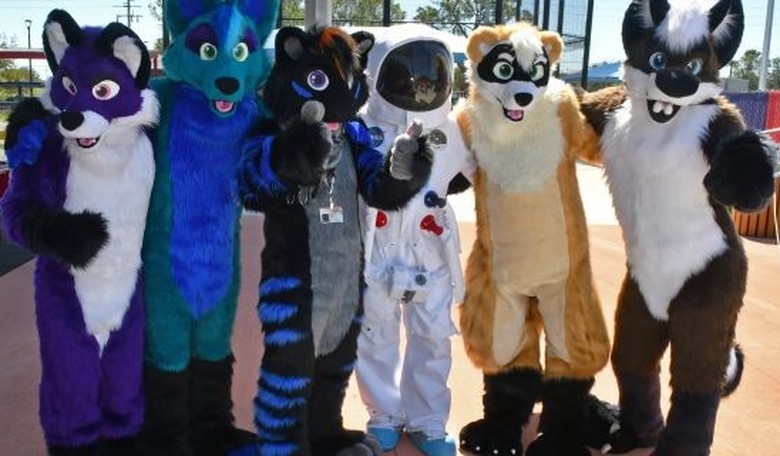
People see adults dressed like giant stuffed animals and they likely think 'they're weird', but probably not much more. Unfortunately, there is nefarious part of the movement, and they are loosely linked to several high-profile incidents of violence against conservatives.
🚨NEW: The Trump assassination attempt. The murder of Charlie Kirk. The ICE shooting in Dallas.
— Colin Wright (@SwipeWright) March 16, 2026
All have links—direct or indirect—to the furry fandom.
For @RealLastStand, a longtime insider explains how parts of the community evolved from a creative hobbyist culture into an… pic.twitter.com/KJnmnPFm5n
I’m a furry.
That’s probably not the sentence most readers expect to see at the beginning of an essay in Reality’s Last Stand. But it’s the truth, and it’s the place I have to start.
For more than two decades I’ve been part of the furry fandom—an online and offline subculture centered around anthropomorphic animal characters, artwork, role-playing, and elaborate costumes called “fursuits.” For most people on the outside, that description probably sounds odd, maybe even absurd and juvenile. But for those of us inside it, the fandom has often felt like something closer to a home: a place where creative people who never quite fit anywhere else could build their own communities.
For a lot of us, it still does.
But over the past several years I’ve watched something inside that community begin to change. Slowly at first, then more visibly. The shift has been subtle enough that many outsiders would never notice it, but those of us who have spent long enough in the fandom can feel it.
And in a few deeply disturbing cases, that shift has spilled out into the real world.
Thomas Crooks, the man who attempted to assassinate Donald Trump frequented in online spaces known for their furry fandom. Charlie Kirk’s likely assassin, Tyler Robinson, had a documented furry fixation, including a FurAffinity account, and even engraved one of his bullet casing with a well-known furry meme. The Dallas ICE facility shooter, Joshua Jahn, also appears to have been involved in the furry community based on several of his social media posts.
That's a whole lot of coincidences.
This essay isn’t meant as an attack on the furry fandom as a whole. It is an attempt to explain how a subculture build around creativity and friendship has, in some corners, become vulnerable to ideological radicalization, social isolation, and increasingly dangerous rhetoric.
The fandom makes for a strange case study. It’s poorly understood by the public and frequently misrepresented by the media. But precisely because of that confusion, it offers a revealing window into how modern online communities can drift toward extremism without many people noticing.
Not the article we wanted…but it’s the article we deserved
— Gummi (@gummibear737) March 16, 2026
The furries have got to be stopped😂
I’m serious🤣 https://t.co/VM5QL6chgO
It's actually very, very serious.
Add 'em to this list of people in need of involuntary mental intervention. https://t.co/sPpkT3AKwU
— Maximum Kong 🇻🇦🇺🇸🇺🇦🇹🇼🇮🇱 (@DankyKong94) March 16, 2026
Imagine that…mentally ill people act like they’re mentally ill. https://t.co/8wHIk2RefR
— Equality 7-2521 🗑️ (@Prometheus_Ego) March 16, 2026
Sexual Deviants and Serial Killers are besties. This is well known. https://t.co/D60efoeXro
— John McElligott (@john_mcelligott) March 16, 2026
We need to have a national conversation about identity-based personality psychopathology. "Furries" & "furry culture" are atypical. They reflect statistical deviance & no amount of wishful thinking or "destigmatization" is going to change that. https://t.co/2pTjWzBj5g
— J.D. Haltigan, PhD 🏒👨💻 (@JDHaltigan) March 16, 2026
Maybe we've allowed the 'live and let live' culture go too far and it's time we brought back shame.